World Press Photo presents a selection of photographs, awarded World Press Photo of the Year from 1955 to 2025, that captured some of the most defining moments in recent history.
The collection highlights issues such as the hope and resilience of protesters, migration, resistance against racism, or the human cost of conflict, and shows how important photojournalism is in shaping our collective memory and creating mutual understanding. Major world events that occurred in the years the photographs were taken are also outlined in the exhibition to provide context and invite the viewer to reflect on the past, present, and future.
Visual stories, documented by multiple voices, play an important role in understanding the world's most significant issues. Press freedom, a foundation of democratic societies, enabled these visual stories to be published. Yet, in many parts of the world, this right is oppressed or under threat, and cannot be taken for granted. Supporting the conditions for press freedom is a fundamental part of World Press Photo's work.
Presented here is a selection of the photographs on display.
Find out more and plan your visit.If you would like to bring this exhibition to your own city, please contact our exhibitions team by emailing:
exhibitions@worldpressphoto.org
Which photographs resonate with you, and why? Share your thoughts on social media using the hashtag #WPPhICONIC.
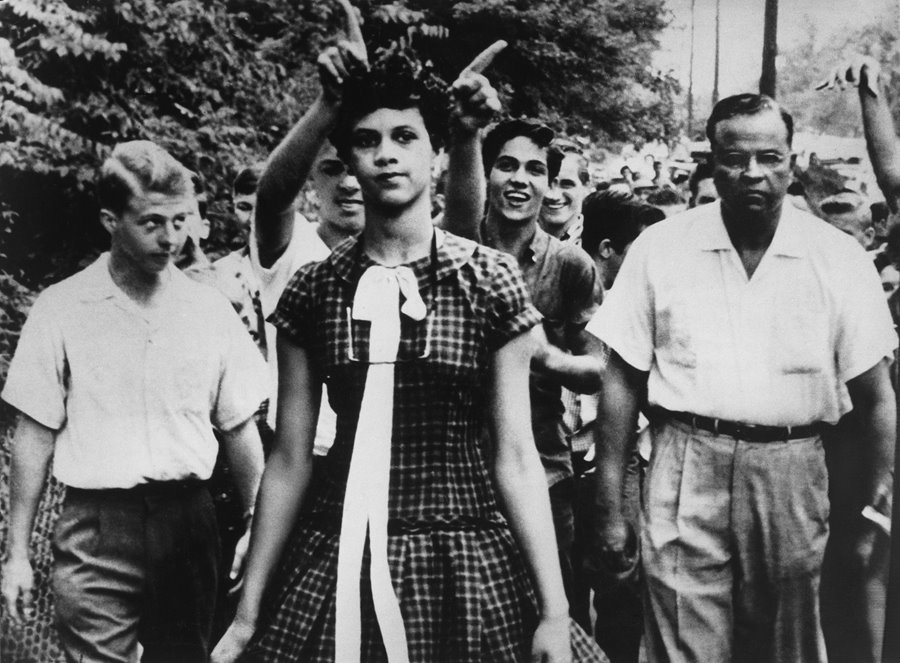
Douglas Martin, 1957
Dorothy Counts, the first and at the time only black student to enroll in the newly desegregated Harry Harding High School in Charlotte, North Carolina, United States, is mocked by protestors on her first day of school, on 4 September 1957. Credit: Douglas Martin, The Charlotte News/Associated Press.
Tension was high in southern districts trying to comply with the Supreme Court's 1954 ruling that public school segregation was unconstitutional. This image, awarded the World Press Photo of the Year in 1957, drew immediate international attention. Writer and civil rights activist James Baldwin wrote that seeing it in Paris led him to return to the United States.
In 2006, Dorothy Counts-Scoggins met Woody Cooper, one of the children in the photo, who wanted to apologize. They shared their story with the media and went on to do numerous speaking engagements and interviews together.
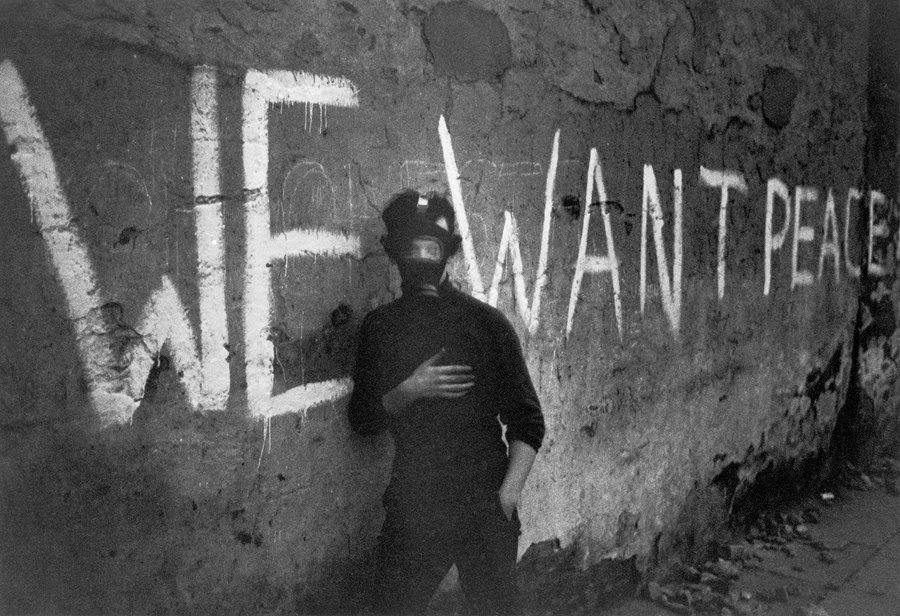
Hanns-Jörg Anders, 1969
A youth wears a gas mask during clashes with British troops in Londonderry, Northern Ireland. People had been fleeing from teargas after a night of street fighting. Credit: Hanns-Jörg Anders.
In 1969, violence broke out in Northern Ireland leading to 30 years of conflict known as the Troubles. Despite the use of the terms Protestant and Catholic to refer to the two sides, the conflict was primarily political rather than religious. Nationalists, who were mostly Irish Catholics, wanted a united Ireland, and loyalists, who were mostly Ulster Protestants, were in favor of Northern Ireland remaining part of the United Kingdom. Sectarian lines still divide parts of Northern Ireland today, 24 years after the 1998 Good Friday Agreement largely ended the Troubles.
This photograph was awarded the World Press Photo of the Year in 1969.
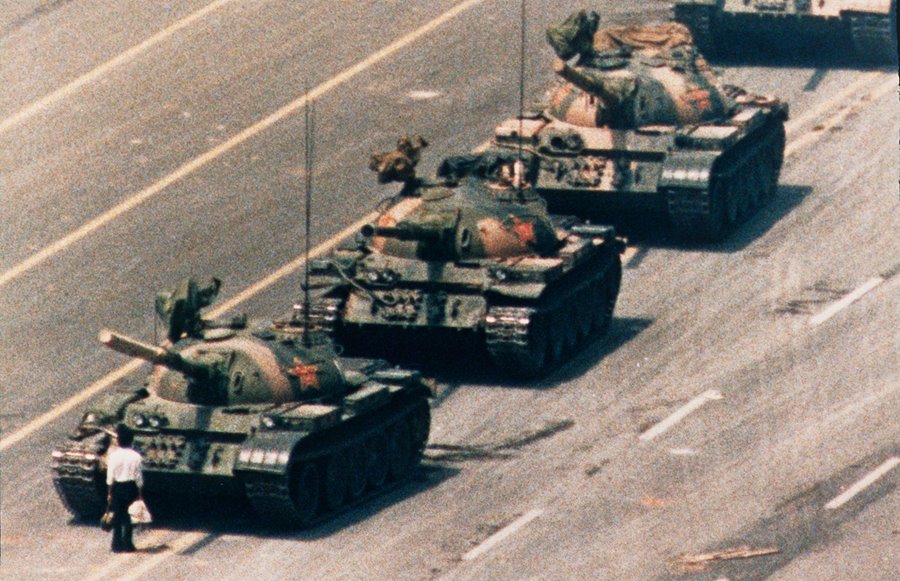
A demonstrator confronts a line of People's Liberation Army tanks on Chang'an Avenue, Beijing, China, during protests for democratic reform on Tiananmen Square, on 5 June 1989. Credit: Charlie Cole, Newsweek.
Tiananmen Square had been the site of non-violent pro-democracy protests for weeks when the military moved in and opened fire on 4 June 1989. Although there has been no publicly released record of deaths, witnesses estimated up to several thousand fatalities.
This photograph, awarded the World Press Photo of the Year in 1990, along with other images of the scene, became an international symbol for peaceful resistance. There is no reliable information about what happened to the unidentified demonstrator and the Tank Man pictures remain banned in China.
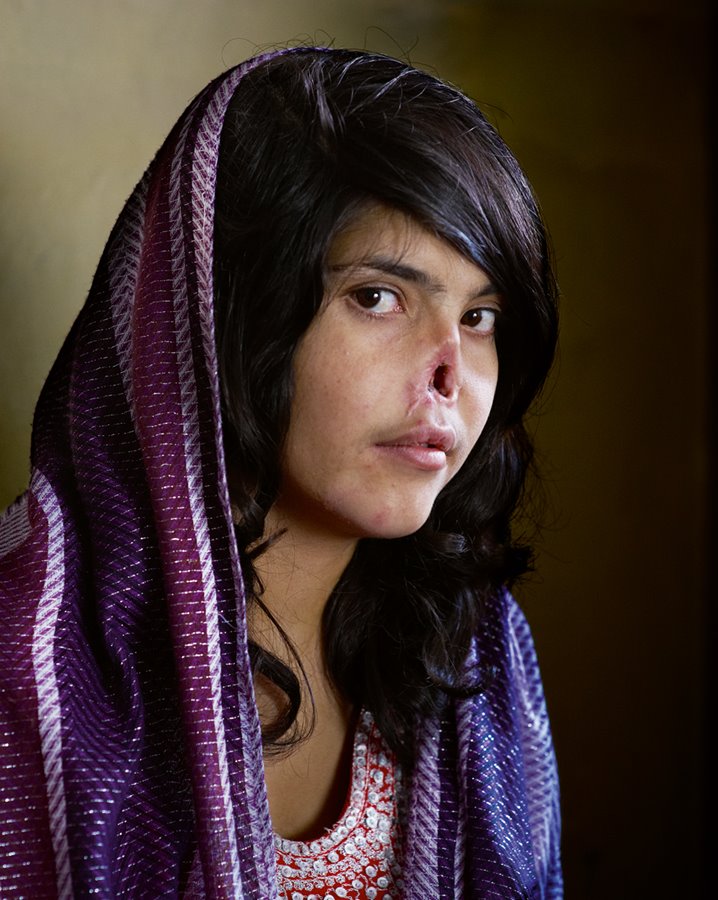
Jodi Bieber, 2011
Bibi Aisha (18), disfigured as retribution for fleeing her husband’s house, at the Women for Afghan Women refuge in Kabul, Afghanistan, on 15 July 2010. Credit: Jodi Bieber, Institute for Artist Management/ Goodman Gallery for Time magazine.
Aisha was forced to marry when she was 12, in a practice, still prevalent in rural Afghanistan, known as baad—the trading of young girls to resolve disputes. After years of abuse, she escaped but was captured by the Taliban and handed over to her husband who cut off her ears and nose. Following nine months at the women’s refuge in Kabul, Aisha was flown to the United States to continue her recovery.
"I could have made a photograph with her looking or being portrayed more as the victim,” the photographer says. “And I thought, No, this woman is beautiful.” The photograph was awarded the World Press Photo of the Year in 2011.
John Moore, 2019
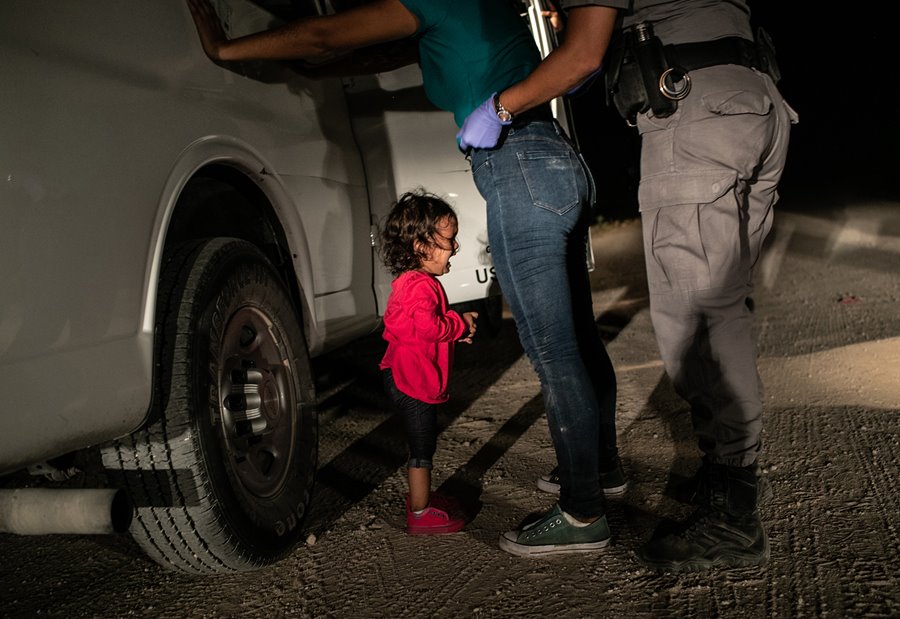
Honduran toddler Yanela Sanchez cries as she and her mother, Sandra Sanchez, are taken into custody by United States border officials in McAllen, Texas, on 12 June 2018, after rafting across the Rio Grande from Mexico. Credit: John Moore, Getty Images.
The Trump Administration’s zero tolerance border policy, stating that migrants caught entering the United States could be criminally prosecuted, resulted in the separation of thousands of families. The impact of Yanela’s evident distress in this image contributed to an enormous public outcry that led to President Trump reversing the policy on 20 June. The photographer says: “As a photojournalist, my job is to inform and report what is happening, but I also think it is important to humanize an issue that is often reported in statistics.”
The image was awarded the World Press Photo of the Year in 2019.
Yasuyoshi Chiba, 2020
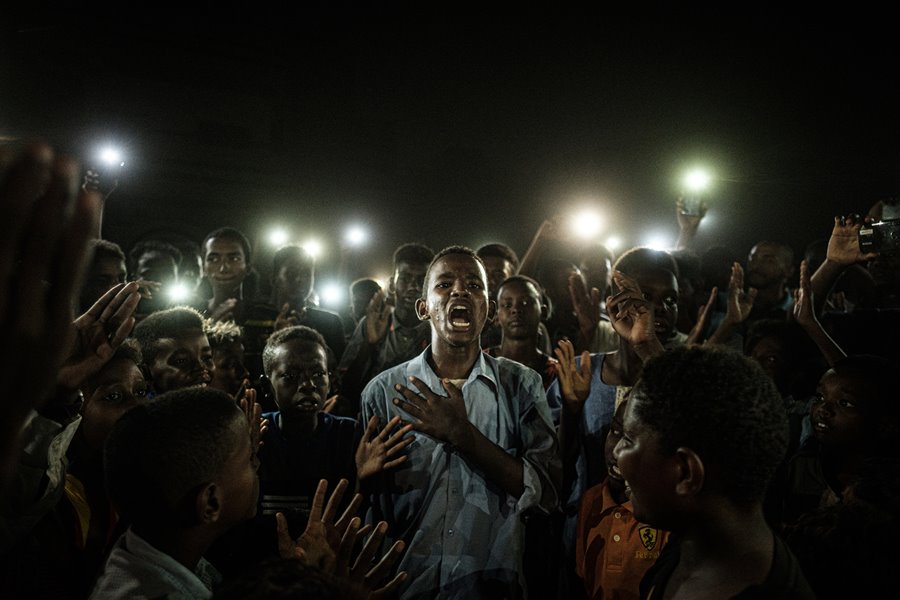
Mohamed Yousif, illuminated by mobile phones, recites protest poetry while demonstrators chant slogans calling for civilian rule, during a blackout in Khartoum, Sudan, on 19 June 2019. Credit: Yasuyoshi Chiba, Agence France-Presse.
Following widespread demonstrations, the 30-year rule of Sudanese dictator Omar al-Bashir had come to an end by a military coup on 11 April 2019. Despite violent military crackdowns, protests continued, calling for power to be handed to civilian groups. When authorities imposed blackouts and shut down the internet, protesters continued communicating via text message, word of mouth, and megaphones. As a result of this image, awarded the World Press Photo of the Year in 2020, in September 2020, Mohamed was able to begin studying in Maastricht, the Netherlands.
Amber Bracken, 2022
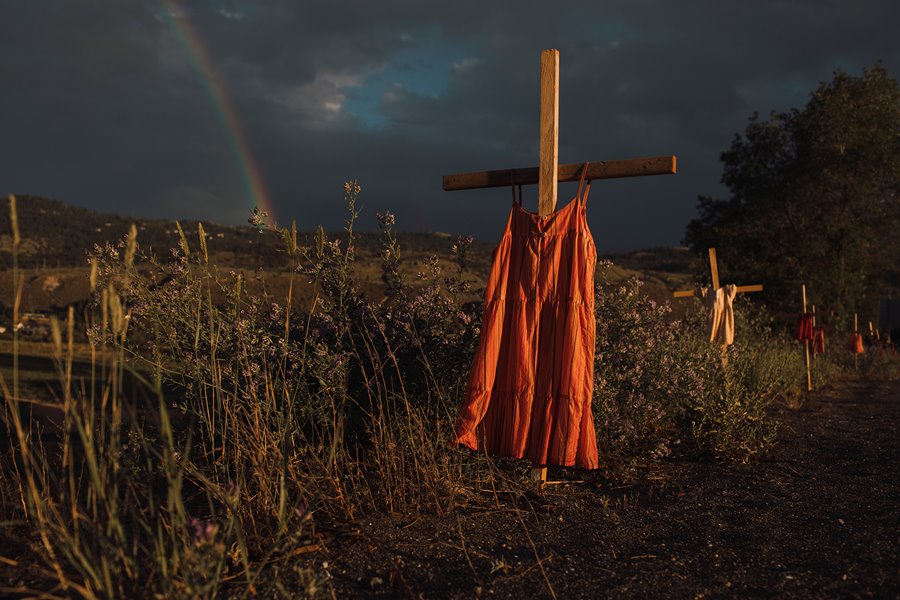
Red dresses hung on crosses along a roadside commemorate children who died at the Kamloops Indian Residential School, following the discovery of unmarked graves, in Kamloops, British Columbia, Canada. 19 June 2021. Credit: Amber Bracken, for The New York Times.
Residential schools were set up by the Canadian government in the 19th century to forcibly assimilate Indigenous youth into the Western culture of European colonists and missionaries. More than 150,000 children were removed from their homes and subject to physical and sometimes sexual abuse. At least 4,100 students died. The Kamloops School became the largest in the system. In May 2021, a survey using ground-penetrating radar identified 215 unmarked graves of children at Kamloops – confirming reports from oral histories.
This photograph, awarded the World Press Photo of the Year in 2022, is the first image without any people in it to be awarded this prize in World Press Photo’s 70-year history.
Evgeniy Maloletka, 2023
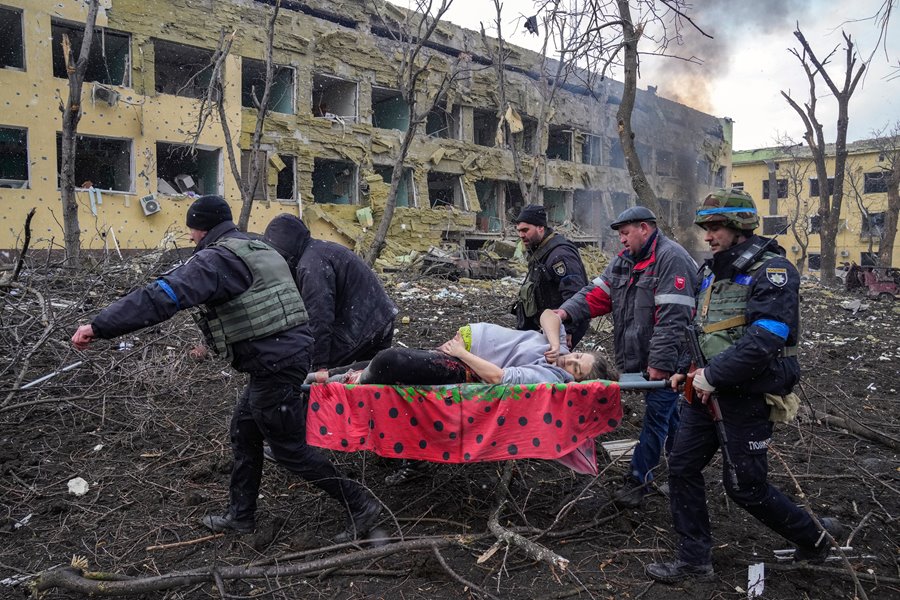
Iryna Kalinina (32), an injured pregnant woman, is carried from a maternity hospital that was damaged during a Russian airstrike in Mariupol, Ukraine, on 9 March 2022. Her baby, named Miron (after the word for ‘peace’) was stillborn, and half an hour later Iryna died as well. Credit: Evgeniy Maloletka, Associated Press.
When Russian forces invaded Ukraine on 24 February 2022, they immediately targeted the strategically important port of Mariupol on the Sea of Azov. By 20 May, Russia gained full control of the city, which had been devastated by shelling, and tens of thousands of civilians had fled or been killed. Maloletka was one of the very few photographers documenting events in Mariupol at that time. The jury felt his story communicated the horror of the war for civilians; they praised the photographer’s resilience while working under immense pressure and imminent threat.
The image was awarded the World Press Photo of the Year in 2023.
–––––
Visitor information
‘ICONIC - Defending press freedom and democracy since 1955’ is on display in multiple locations worldwide. If you would like to bring ICONIC to your city, please get in touch with our Exhibitions team by emailing:
exhibitions@worldpressphoto.orgOpening soon in: